Northwest Side IT Firm Scores: How the Bands Spread
Chapters
Disclosure: this site is owned and operated by XL.net, a Chicago MSP that is itself ranked here. How we handle that conflict.
What do northwest side IT firm scores look like across three bands?
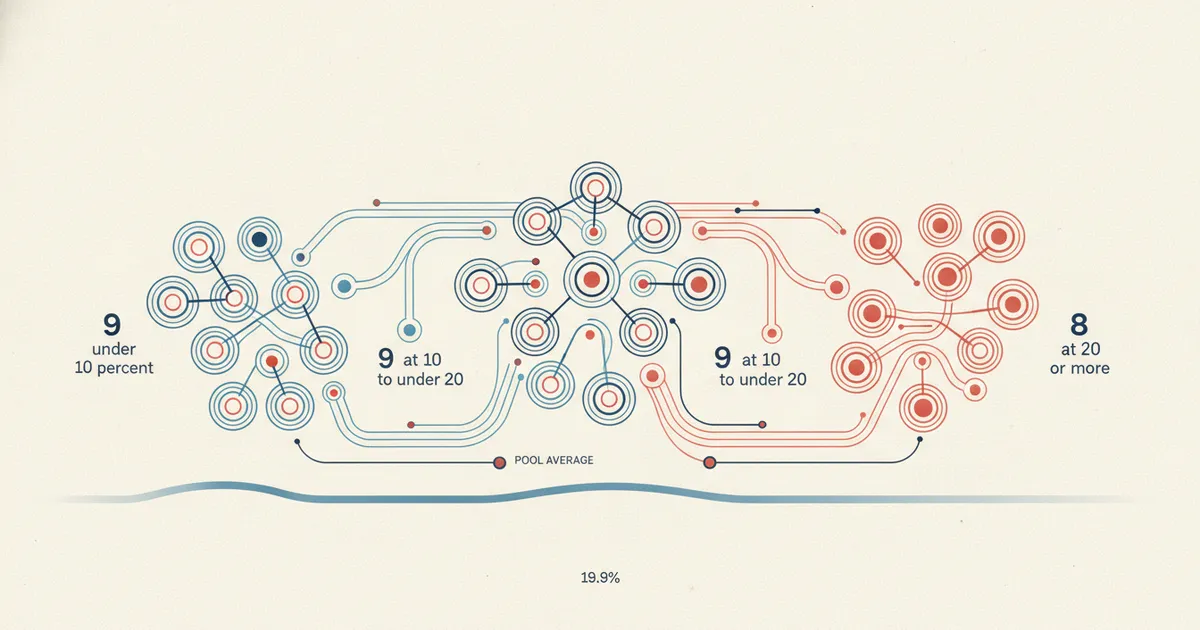
Northwest firms spread across all three score bands rather than clustering in one. IT Support Chicago's area table counts 9 northwest firms under 10 percent, 9 at 10 to under 20, and 8 at 20 or more.
The group is made up of tracked IT firms whose nearest Google listing sits five miles or more from downtown Chicago, on a bearing between west-northwest and northwest. The band is a percentage of our published score, which combines four criteria scored from public evidence: client reputation, employee reputation, proactive issue reduction and security certification.
Because the three cells are close in size, we do not describe the northwest group as high-scoring or low-scoring. It holds firms across the whole spread.
Coverage also differs by criterion. Proactive issue reduction is scored for 54 of 102 firms and security certification for 91 of 102. A band tells you where a score landed, not which criteria produced it, so check the parts of a firm's score before leaning on the total.
| Score band (percent) | Northwest firms |
|---|---|
| Under 10 | 9 |
| 10 to under 20 | 9 |
| 20 or more | 8 |
TL;DR
Northwest side IT firm scores spread across all three of our bands. Of the 26 firms whose nearest Google listing sits northwest of downtown, 9 score under 10 percent, 9 score from 10 to under 20 percent, and 8 score 20 percent or more. Set against a pool-wide average of 19.9% (range 0.8% to 82.3%), that is a pattern across a group, not a verdict on any firm, and we rank no area against another.
- The northwest group's cells are 9, 9 and 8 firms, so no single band defines the group.
- The pool-wide average score is 19.9%, with a range of 0.8% to 82.3% across the firms we track.
- A sector marks where a firm's nearest listing sits, not where it serves, staffs or responds.
- We draw no comparison that calls one area's firms better or worse than another's.
- A firm's band within the northwest group is no reason to include or exclude it from a shortlist.
How do the northwest bands sit against the pool-wide average and range?
The northwest bands sit inside a pool far wider than any one area's cells show. IT Support Chicago's vendor data puts the pool-wide average score at 19.9%, with a range of 0.8% to 82.3%.
That average falls inside the 10 to under 20 band, and the open-ended 20 or more band cannot show how far above 20 any firm sits. The top of the pool's range is therefore invisible in a three-band cell, and so is the bottom of the first band.
We publish IT firm score bands by area as counts of firms, never as an average for an area, so we cannot tell you what the northwest group's own average is. Other sectors in the same table are reported in coarser cuts, such as under 20 and 20 or more, which means no like-for-like comparison exists. We would not rank areas even if one did.
For how the spread looks across the whole pool of 102 tracked firms, see our read on score ranges.
How big is the northwest group, and who falls outside it?
The group is sizeable, though every cell still describes a pattern in our records and never a single firm. IT Support Chicago's area table places 26 firms in the northwest sector by nearest Google listing.
That group sits among the 97 of 101 tracked firms we could place, meaning those with a listing within 100 miles of downtown and usable coordinates. The other sectors hold core 30, north 7, west 18 and south 16 firms. We list those counts for scale only.
Each firm is placed once. If its nearest listing is under five miles from downtown, it counts in the core, and otherwise it counts in a compass sector by bearing. Chicago IT firm listings northwest of downtown therefore count toward the northwest group only when no nearer listing exists. Of the 30 core firms, 19 also have a listing in another sector, yet each of those firms is counted once, in the core. Our write-up of how the downtown core is counted covers the rule in detail.
A cell of 8 or 9 firms is small, so a change in a single firm's score can shift it. Treat the cells as a snapshot of our records, not a fixed feature of an area. For transparency, XL.net, which owns this publication, is in no figure in the area table.
What can a sector cell not tell a buyer?
A sector cell cannot tell a buyer where a firm serves, where its staff are, or how quickly it responds. IT Support Chicago's area method records where a firm's nearest Google listing sits, not its service area, staffing or response time.
Reading area cells in our pool starts with the listing itself. A listing is not an office we visited, and our listing counts can miss listings or include closed ones. Distance is straight-line from downtown, not a drive time. Our guide to what a Google listing type tells buyers goes further on that limit.
The same caution covers the other northwest cells. Nine northwest firms have a certification listed, and the client-review cell splits 18 firms under 50 and 8 at 50 or more. Certifications and review counts belong to the whole firm, not to one listing. A certification listed in our records is not an audit result from us, and it says nothing about how secure a firm is.
Nothing in the table shows where a firm sends technicians. A firm with a northwest listing may serve clients across the metro area, and a firm with no listing there may still serve the northwest side.
How should a Chicago buyer use northwest bands when shortlisting?
IT Support Chicago advises that a firm's band within the northwest group is no reason to include or exclude it from a shortlist.
Instead, put the questions to each Managed Service Provider (MSP) directly. Ask where its staff are based, who handles on-site visits, and what response commitments it will put in writing. Ask for evidence behind any certification it cites, and check that evidence yourself. Then read the four parts of its score instead of the total.
Some buyers do need a provider within reach of a northwest-side office, and that need is legitimate. A listing proves little about it, so confirm it with the firm.
On fit, our position is that right-sizing matters more than the size of a provider, and a band says nothing about whether a firm suits a company of your size. On contract terms, we advise shorter agreements, which let you test the fit rather than infer it. For agreements under a year, we see termination, not service-level penalties, as the better recourse if service falls short. Chicago MSPs reading these cells should treat them the same way: a pattern across a group, not a verdict on their own firm.
Frequently asked questions
Do northwest firms score higher or lower than firms in other areas?
We draw no such comparison and do not rank areas. The other sectors in our table are reported in coarser score cuts, so the cells cannot be set side by side.
Does a northwest listing mean a firm serves the northwest side?
No. A sector marks where a firm's nearest Google listing sits, not where it serves or sends staff. Ask the firm directly about coverage.
Can I see which firms are in the northwest group?
This article publishes counts only and names no firm in any cell. The cells describe a pattern across the group, never an individual firm.
What should an MSP take from its own band?
Nothing about the firm specifically. The band cells describe a group, and a firm's own score profile shows how its four scored criteria contributed.